For filter cleaning companies
DPF cleaning fluid for DPF cleaning machines
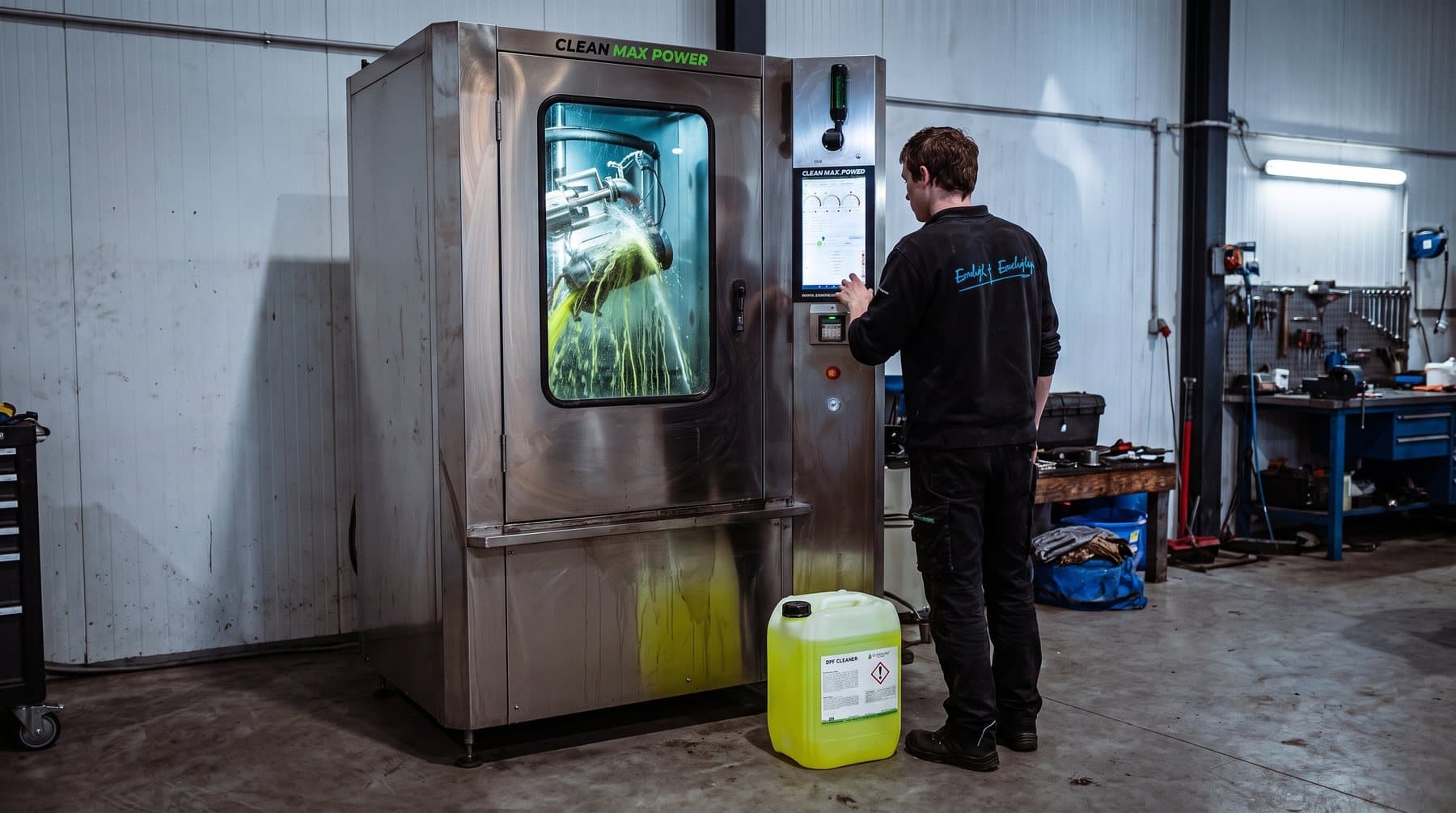
DPF Cleaner is the concentrate that goes into the tank of your filter cleaning machine. It is alkaline, water-based and does not foam, so the pump keeps drawing liquid instead of air. We produce it ourselves in the Netherlands and supply it from a trial bottle up to 1000 litre IBCs.
- Dilution
- 1:10 to 1:5
- Working temperature
- 60 to 70 °C
- Dwell time
- 30 to 60 min
- Foaming
- None
What a cleaning machine asks of the fluid
A DPF machine heats the bath, forces it through the channels under pressure and keeps it circulating for half an hour or more. That is where a cleaning chemical shows what it is worth.
- No foam. With a pump moving hundreds of litres a minute, foam makes it draw air, the pressure drops and the tank runs over. DPF Cleaner stays liquid at the right dilution, also after hours of circulating.
- Made for heat. The working range is 60 to 70 °C, which most machines hold by themselves. It works cold as well, only slower.
- Concentrate. 1:10 for normal fouling, 1:5 for filters that have run on for a long time. You pay freight on product, not on water.
- A fill lasts. A tank is not spent after one filter: you run several through it until the liquid saturates.
- Paperwork included. The technical data sheet and the safety data sheet come with the first delivery, so you can sign it off internally.
What a tank costs you
For a filter cleaning business the useful figure is not the price per can but the price per tank. At 1:10 a 100 litre tank takes 10 litres of concentrate, at 1:5 it takes 20. The block further down works that out with the current prices from our catalogue.
With heavy fouling, let the programme run longer rather than dosing higher. That keeps the cost per tank where you planned it.
Machine, immersion bath or ultrasonic tank
Most filter cleaners work with a machine that jets under pressure. Rebuild shops often use a heated immersion bath or an ultrasonic tank instead. The dilution is the same; in a bath you let it stand instead of jetting, so count on a longer dwell time.
The same fill also takes catalysts, SCR units, metal filter elements and parts with baked-on soot such as exhaust sections, turbo parts, grilles and housings.
A filter through the machine
- 01
Blow out and measure
Blow the loose soot out dry with compressed air before the filter goes in. What comes out there does not have to be dissolved. Measure the back pressure so you know where you started.
- 02
Fill and dose
Fill the tank with water and add the concentrate: 1:10 for normal fouling, 1:5 for filters that have run on for a long time. Let the machine bring it to 60 to 70 °C.
- 03
Run the programme
Clamp the filter in the cabinet and start the programme. Count on 30 to 60 minutes. For heavy fouling, extend the time rather than the dose.
- 04
Rinse, dry, measure
Rinse with clean water until the rinse water stays clear. Dry it fully with warm air and measure the back pressure again before the filter goes back on the vehicle.
What it does not do
- It does not repair a cracked or melted ceramic element. You see that when you blow it out and measure; no cleaner brings that filter back.
- It is not a fuel additive and never goes into a fuel tank.
- It should not stand undiluted on aluminium or painted parts. Diluted and rinsed off, it is fine on most metals.
- It does not tell you why a filter blocked. That is a diagnosis on the vehicle.
Trial and prices
Run it in your own machine.
Start with a trial at your usual programme, next to what you use now. The technical data sheet and the safety data sheet come with it. Prices below come straight from our catalogue.
- Shipped within 5 working days
- Technical and safety data sheets included
- Produced in the Netherlands
Trial: DPF Cleaner Bottle 1 L
€12.50 excl. VAT€15.38 incl. VAT
Concentrate per 100 litre tank
- At 1:10: 10 litres of concentrate, from €31.50
- At 1:5: 20 litres of concentrate, from €63.00
Concentrate from €3.15 per litre excl. VAT, depending on pack size and quantity. Excluding VAT, at the lowest tier price. The order block shows the exact price per pack size.
Questions
What filter cleaners ask.
Which DPF cleaning machines can I use it in?
It is made for the DPF machines that stand in filter cleaning workshops: you fill the tank, the machine heats the liquid and jets it through the filter under pressure. It does not foam, which is what those pumps need. Without a machine, a heated immersion bath or an ultrasonic tank works at the same dilution, it just takes longer.
How much concentrate goes into a tank?
At 1:10, one litre of concentrate per ten litres of water; at 1:5, one per five. For a 100 litre tank that is 10 or 20 litres. The fill is not spent after one filter: you run several through it until the liquid saturates.
Does it foam in a machine with a strong pump?
No. At the right dilution it stays liquid, also after hours of circulating. That keeps the pump from drawing air and the tank from running over.
What temperature should the tank be?
60 to 70 °C. It also works cold, but slower, so cold water costs you machine time.
Can I buy it in bulk or under my own brand?
Pack sizes are 1, 5, 10, 20, 200 and 1000 litres, and the price per litre drops with the volume. From a fixed annual volume we also produce it under your own label. Email support@cleanline.nl.
Do I get a technical data sheet and a safety data sheet?
Yes, both, with the first delivery, so you can sign the product off internally.
Applications